




Is Tinubu Waging a Quiet War on the Muslim North? A Necessary Response
Is Tinubu Waging a Quiet War on the Muslim North? A Necessary Response
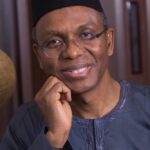
By: Bolaji Olabode
There is something fundamentally disingenuous about the recent essay by Mohammed Bello Doka, shared by former Kaduna State governor, Nasir El-Rufai, which purports to ask questions while quietly supplying prepackaged conclusions. The piece presents itself as reflection, but in truth, it is religious mobilisation disguised as political concern.
Nigeria is not a theocracy, and politics is not religion. Any attempt to reduce appointments, budgets and national security decisions to a binary of Muslim North versus others is not only intellectually shallow but socially incendiary. That this narrative is being amplified by El-Rufai is especially troubling, given his own record in public office.
If religious arithmetic is now the measure of justice, then the administration of former President Muhammadu Buhari (2015–2023) must be the appropriate benchmark. During that period, key national institutions—defence, intelligence, internal security, petroleum, customs, immigration, the DSS and much of the security architecture—were overwhelmingly dominated by Northern Muslims.
This was not conjecture. It was widely documented by civil society groups, the media and international observers. Yet neither El-Rufai nor those now crying marginalisation described that era as a “quiet war” against Christians, the South or the Middle Belt. Silence then was not accidental; it was consent.
What has changed is not injustice, but political advantage.
It is particularly ironic that El-Rufai would circulate an essay lamenting violence and abandonment when Kaduna State, under his administration, became one of Nigeria’s most violent flashpoints. Southern Kaduna suffered years of mass killings and displacement, while citizens were repeatedly warned against “politicising” insecurity.
Kaduna’s highways became synonymous with abductions and banditry, and schools were targeted with alarming regularity. If persistent insecurity is evidence of presidential hostility, then the same logic would indict El-Rufai’s tenure as deliberate aggression against his own people.
The most dangerous assumption in the essay is the idea that political power is the birthright of the “Muslim North,” and that any redistribution amounts to persecution. This narrative diminishes Northern Christians, reduces Muslims to a monolithic voting bloc and entrenches identity politics as Nigeria’s organising principle.
President Bola Tinubu was not elected to maintain a sectarian balance sheet. Appointments are not rewards for electoral sacrifice; they are instruments of governance. Those who are alarmed today were conspicuously comfortable when power was heavily concentrated in their favour.
The attempt to drag Vice President Kashim Shettima into speculative 2027 calculations is crude fear-mongering. Vice Presidents are constitutional officers, not religious symbols. Political coalitions evolve, and no region is entitled to permanent leverage.
Northern votes are not weapons to be brandished, and Southern votes are not provocations to be feared. Any elite—North or South—that suggests otherwise betrays a troubling disdain for democracy.
The real betrayal lies not in President Tinubu’s appointments, but in a political elite that monopolised power, failed to secure its people and now seeks relevance by stoking religious and ethnic anxieties. Nigeria’s challenge is not the loss of Muslim power; it is the persistence of bad leadership masquerading as victimhood once influence wanes.
Nasir El-Rufai knows better. He has previously argued—correctly—that Nigeria cannot survive sustained ethnic and religious division. That makes the promotion of this narrative particularly disappointing.
This is not a warning; it is an incitement framed as concern.
Politics is not religion. Governance is not entitlement. And no group—Muslim, Christian, Northern or Southern—has a monopoly on Nigeria.
History is watching, and it is not confused.
—
Bolaji Olabode is a public affairs analyst and commentator on governance, democracy and national cohesion. He writes on political accountability, institutional reform and the intersection of leadership and national unity in Nigeria.
TRENDING SONGS
 Tragedy in Ondo: Police Arrest Man for Allegedly Stabbing Friend to Death
 Sanwo-Olu Unveils $25m Education Fund to Tackle Out-of-School Crisis in Lagos
 Osun PDP Crisis Deepens as Party Group Appeals to Wike for Urgent Intervention
 Suspected Thugs Attack Benue PDP Media Consultant, Burn Vehicle in Makurdi
 Police Bust Car Theft Ring in Kano, Recover Four Stolen Vehicles
 Keyamo Insists No Turning Back on Cashless Payments at Airports
 PDP Crisis Deepens as Wike, Turaki Camps Clash Over Convention Plans
 Petrol Import Ban Sparks Industry Rift as Dangote Refinery Raises Price to N1,175
 Ibadan Pastor Agbala Gabriel in Storm Over Fraud, Sex Allegations
 “People Focus on My Boobs, Not My Talent” — Actress Queeneth Agbor Speaks Out
Share this post with your friends on