







Aso Rock Under Siege: Uncovered Plot to Kidnap Tinubu and Top Officials
Aso Rock Under Siege: Uncovered Plot to Kidnap Tinubu and Top Officials
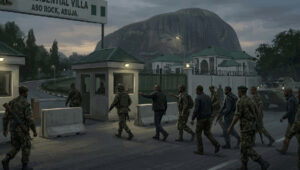
Fresh revelations have brought to light a chilling and highly coordinated plot allegedly designed to seize control of Nigeria’s seat of power, with investigators uncovering plans that targeted the Presidential Villa, top political leaders, and key military installations in Abuja.
Multiple security sources indicate that the suspected conspirators mapped out a detailed operation aimed at storming Aso Rock, capturing President Bola Tinubu and Vice President Kashim Shettima, and dismantling the country’s command structure in a swift and decisive takeover. Premium Times reports that the plot went beyond isolated intentions, evolving into what officials described as a structured military-style operation with designated units and timelines.
According to findings, the plan included a specialised strike team tasked with breaching the heavily guarded Presidential Villa. The mission allegedly extended to high-ranking political figures, including Senate President Godswill Akpabio and House Speaker Tajudeen Abbas, who were identified as key targets in the operation.
Security insiders revealed that the strategy also focused heavily on neutralising Nigeria’s defence leadership. Senior military officers were reportedly assigned roles to eliminate top commanders, including the Chief of Defence Staff and service chiefs, in a move intended to cripple any immediate response. The Guardian has similarly reported concerns within security circles about the increasing sophistication of internal threats to national stability.
Beyond the Presidential Villa, the alleged blueprint outlined simultaneous strikes on critical national assets. Troops linked to the conspiracy were said to be positioned to take control of the Niger Barracks, a strategic military base overlooking Aso Rock, as well as the Armed Forces Complex in Garki. Another operational unit was reportedly assigned to secure the Nnamdi Azikiwe International Airport, effectively restricting movement in and out of the capital.
One senior official familiar with the investigation described the operation as “deeply coordinated and far-reaching,” noting that it combined tactical military planning with logistical and psychological elements aimed at consolidating power within hours.
The scope of the alleged network has also raised alarm. Investigators disclosed that over 40 individuals, including senior military officers and civilians, were implicated. Among them were personnel from elite units, as well as non-military collaborators tasked with logistics and communication. Daily Trust notes that the involvement of both military and civilian actors underscores the complexity of the suspected plot.
Authorities further uncovered a cache of weapons and operational equipment believed to be linked to the group. Recovered items reportedly included armoured vehicles, heavy machine guns, rocket-propelled grenades, and large volumes of ammunition. Officials say the scale of the arsenal points to a level of preparedness that heightened fears about how close the plan may have come to execution.
The arrests were carried out during a covert joint operation involving the military and the Department of State Services. While several suspects remain in custody, investigations are ongoing, particularly into alleged financiers and civilian collaborators.
Meanwhile, the Defence Headquarters has confirmed that preliminary investigations have been concluded and forwarded to the appropriate authorities for further action. The Nation reports that military authorities have described the incident as a serious breach of discipline and a threat to national security.
However, the development has also sparked controversy. Families of some detained suspects have pushed back against the official narrative, alleging prolonged detention without trial and calling for transparency in the judicial process. They have demanded open court proceedings, insisting that due process must be followed.
As the case moves toward prosecution, attention is now fixed on how the government will handle the trial whether through public judicial proceedings or internal military tribunals. The outcome is expected to test both Nigeria’s justice system and its commitment to accountability in matters of national security.
TRENDING SONGS
 EFCC Seizes Malami’s Abuja Home Amid Ongoing Legal Battle
 FG’s Power Reforms Pay Off: $2bn Flows In, Sector Debt Slashed Dramatically
 UK Court Jails Nigerian for Life Over Brutal Street Killing in Leicester
 ‘More Driven Than Ever at 41’: Hamilton Fires Warning as Ferrari Revival Gains Momentum
 IOC Sparks Global Debate with Return of Gender Testing Ahead of 2028 Olympics
 Obi–Kwankwaso Alliance Talk Dismissed as ‘Empty Threat’ by Pro-Tinubu Igbo Group Ahead of 2027
 APC convention to showcase party unity, democratic strength — FG
 EFCC Distances Itself from Kwara Poly Unrest, Says Operation Occurred Off-Campus
 IOC Brings Back Gender Verification Tests Ahead of 2028 Los Angeles Olympics
 “Maguire Reflects on Amorim’s Man United Exit: ‘It Just Didn’t Work Out’”
Share this post with your friends on