












Beyond the Ede–Osogbo Boundary Dispute: KRAD’s Osun Capital Territory Thesis as a Blueprint for Metropolitan Development*
 *Beyond the Ede–Osogbo Boundary Dispute: KRAD’s Osun Capital Territory Thesis as a Blueprint for Metropolitan Development*
By Ayobami Sijuade
Politics often thrives on division; statesmanship, however, is measured by the ability to find solutions that render divisions irrelevant.
For decades, discussions surrounding the Osogbo–Ede boundary question have been shaped by history, sentiment and political rhetoric. Successive administrations have had to contend with the consequences of this lingering dispute, while political actors have, at different times, sought to leverage it for electoral advantage. Amid these recurring debates, one proposition stands out for refusing to be constrained by the past and instead focusing on the future.
Senior Advocate of Nigeria, Kunle Rasheed Adegoke, popularly known as KRAD, has consistently maintained that the most enduring solution lies not in redrawing boundaries but in reducing their significance through purposeful and inclusive development. His thesis is both simple and profound: the best government policy is one that promotes development so comprehensively that administrative boundaries become largely inconsequential.
This philosophy came into sharper focus in 2017 during his familiarisation visit to Ede as an aspirant for the governorship of Osun State on the platform of the All Progressives Congress (APC). When asked how, as an indigene of Osogbo, he intended to address the long-standing boundary dispute between Osogbo and Ede, Adegoke resisted the temptation to take sides. Instead, he proposed the full implementation of the Osun Capital Territory Development Scheme. His response shifted the conversation from territorial claims to shared prosperity.
Drawing inspiration from the growth trajectory of metropolitan Lagos, Adegoke argued that successful urban centres evolve by integrating neighbouring communities into a single economic and social ecosystem. He projected that, if properly implemented, the Osun Capital Territory could emerge as the third-largest urban centre in South-West Nigeria after Lagos and Ibadan by 2040.
This was not merely an aspirational slogan. It was a strategic framework for urban planning and regional development. Rather than encouraging competition between Osogbo and Ede, KRAD envisioned an integrated metropolitan region in which development would extend seamlessly across communities, making historical rivalries increasingly irrelevant. He further elaborated on this vision in 2025 during an APC stakeholders’ meeting in Ido Osun.
On that occasion, he identified the local government areas that could form the proposed Capital Territory: Osogbo, Olorunda, Ede North, Ede South, Egbedore, Boripe, Orolu, Irepodun and Ifelodun. Under such a framework, infrastructure development, transportation systems, industrial expansion, housing, environmental management, healthcare and education would be planned and coordinated on a metropolitan scale rather than through isolated local government initiatives.
The objective is straightforward: to create a single, interconnected urban economy capable of driving sustainable growth across the region.
History offers numerous examples of successful capital cities and metropolitan areas evolving through integration rather than fragmentation.
Modern Lagos is no longer defined solely by Lagos Island. Ikeja, Agege, Mushin, Isolo, Ejigbo, Surulere, Yaba, Lekki and several other districts function as components of one expansive metropolitan economy. For most residents, the precise location of local government boundaries is of little consequence because roads, commerce, transportation networks and public infrastructure have effectively blurred those invisible lines.
It is this model that KRAD repeatedly invokes.
During a recent television interview, when asked about allegations that Governor Ademola Adeleke’s administration had marginalised Osogbo in the distribution of infrastructure projects and political appointments, Adegoke once again returned to the same central thesis rather than inflaming the Osogbo–Ede debate. He argued that the most effective role of government is to facilitate development in a manner that renders boundaries insignificant, asking rhetorically where the boundaries between Ikeja and Agege, or Isolo and Ejigbo, truly exist within the daily realities of Lagos residents.
Those remarks reveal a philosophy that extends beyond politics. At its core is the belief that economic integration is a far more powerful force than political division.
When highways connect communities, industries generate employment across municipal lines, public transport systems link neighbouring towns, and schools and hospitals serve wider metropolitan populations, historical disputes gradually lose their relevance. Likewise, when government institutions and public investments are designed to benefit an entire capital region rather than isolated localities, the incentives for rivalry diminish considerably.
This explains why many of the world’s most successful urban centres have embraced metropolitan governance models rather than allowing administrative boundaries to dictate development outcomes.
Viewed through this lens, the proposed Osun Capital Territory should not be regarded merely as an administrative reform. It is fundamentally an economic development strategy. Such a framework could accommodate a metropolitan transport authority linking all participating local governments, a unified physical development master plan, coordinated industrial and commercial corridors, regional waste management systems, integrated water and energy infrastructure, modern housing schemes, satellite town development initiatives, common investment promotion strategies and a digital governance platform capable of enhancing service delivery across the region.
The potential benefits are significant. Businesses would gain access to a larger and more integrated market. Investors would engage with a sizeable urban economy rather than a collection of fragmented jurisdictions. Residents would enjoy greater access to employment opportunities, healthcare, education and transportation. Government planning would become more efficient, reducing duplication and promoting balanced growth throughout the capital region.
Most importantly, the politics of allocation and entitlement could gradually give way to the economics of shared prosperity.
The Osogbo–Ede conversation should therefore not be reduced to a contest over territorial identity or political symbolism. Rather, it should evolve into a broader discussion about how Osun can build a globally competitive capital region capable of attracting investment, creating jobs and driving sustainable economic development.
KRAD’s thesis challenges Osun to think beyond inherited divisions. It encourages policymakers to replace boundary politics with metropolitan planning, local rivalries with regional integration, and historical grievances with a shared vision of progress.
Ultimately, the most important question is no longer where one town ends and another begins. The real challenge is whether Osun is prepared to build a capital territory that future generations will inherit with pride: a modern metropolitan region where prosperity, opportunity and development—not boundaries—define the relationship between neighbouring communities.
That remains the enduring promise of the Osun Capital Territory thesis.
*Ayobami Sijuade is of Post-Graduate School, Political Science at Obafemi Awolowo University, Ile-Ife, Osun State*
TRENDING SONGS
 YOUNG FEMALE MORTICIAN REVEALS WHY MORTUARY ATTENDANTS KNOCK BEFORE ENTERING
 Sanwo-Olu Tours Massive Tolu Education Hub Set to Transform Learning for 20,000 Lagos Students
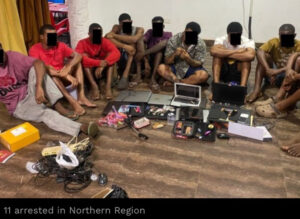 Ghana Police Arrest 11 Nigerians in Tamale Crackdown on Drugs, Cybercrime
 Malami Breaks Silence on INEC–ADC Dispute, Urges Calm Amid Political Tensions
 £746m Nigeria–UK Deal Sparks Debate Over Ajaokuta Steel’s Future
 FG Kicks Off 56km Ekiti–Osun Link Road to Boost Regional Trade
 Tinubu Condemns Plateau and Kaduna Attacks, Calls for Urgent Action Against Violence
 Tonto Dikeh Opens Up on Dark Past: From Cult Involvement to Spiritual Renewal
 Alleged Truck Tampering Lands Lagos Man in Court Over Theft Claims
 Senegal Tightens Anti-LGBTQ Laws, Doubles Prison Terms Amid Rights Concerns
Share this post with your friends on